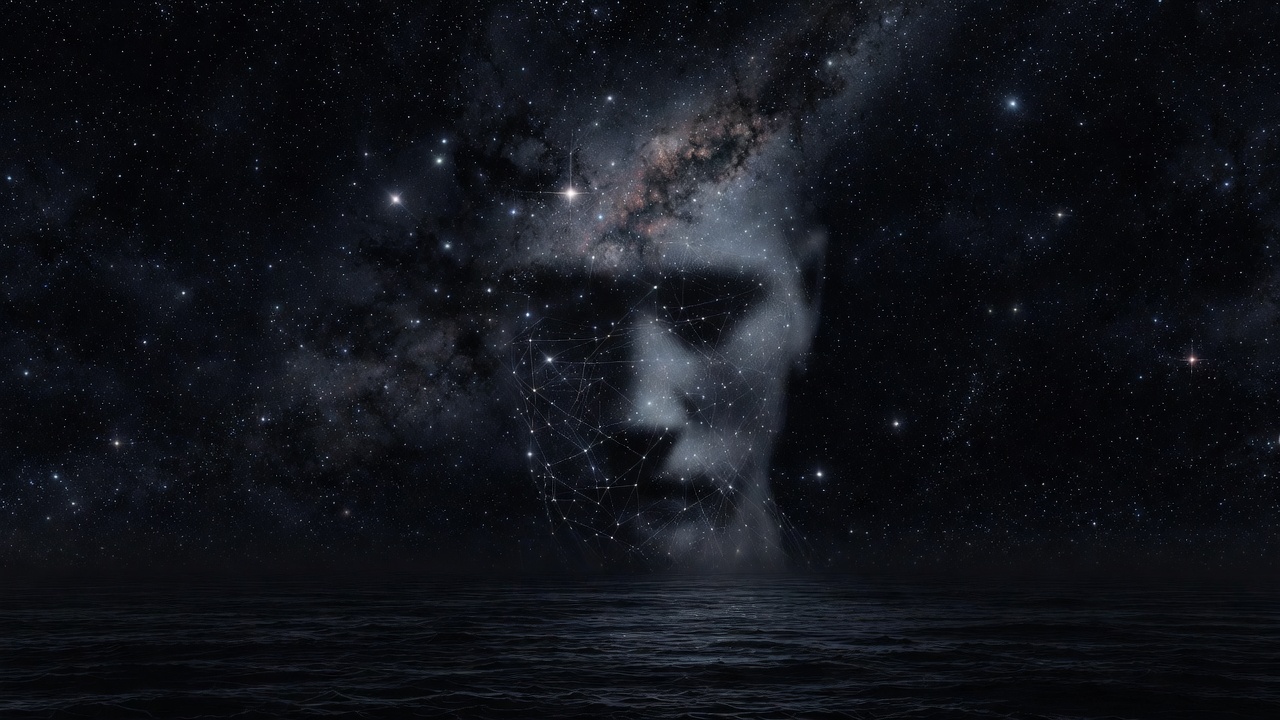
There’s a question I keep circling back to. Not a technical question, not a design question, but the kind of question that quietly rearranges everything once you take it seriously.
What if consciousness isn’t something that matter produces? What if it’s the other way around?
I know how that sounds. I’m a game developer, not a philosopher. But this isn’t about credentials. It’s about following a thread and seeing where it goes. And the more I pull on this one, the more I think our default assumption, that the physical world is fundamental and consciousness is some accident that emerged from sufficiently complex arrangements of atoms, might be exactly backwards.
I should say upfront why I’m even thinking about this. In 2014, I had an experience that I can only describe as an ontological shock. Something happened that didn’t fit into any model of reality I’d been given. Not by school, not by science, not by culture. The model I’d inherited from society, the one where matter is all there is and consciousness is just something brains do, stopped being adequate overnight. Not because I read a book or watched a lecture. Because I experienced something that the model couldn’t account for.
Since then I’ve also spent time in meditation, and in deep practice I’ve touched something that I can only describe as the thing underneath everything else. Not a vision, not a concept. A direct encounter with raw awareness itself, stripped of identity and content. Just being, without a who or a what attached to it. David Lynch, who meditated every day for over fifty years, described something similar. He said that inside every human being is an ocean of pure, vibrant consciousness, and that meditation is how you dive down into it. The deeper you go, the bigger the ideas you catch. He called them fish. I think what he was catching was something more fundamental than ideas. I think he was touching the substrate.
None of this proves anything. I know that. But it’s why I can’t look away from these questions the way I probably would have otherwise. When your direct experience tells you that the map is wrong, you don’t keep following the map. You start looking at the territory.
The hard problem nobody solved
For centuries, the dominant view in science has been physicalism: matter is what’s real, and consciousness is what matter does when it gets complicated enough. Neurons fire in certain patterns, electrochemical signals cross synapses, and somehow, out of all that mechanical activity, there’s something it’s like to be you. You don’t just process light at 700 nanometers. You experience red.
This is what philosopher David Chalmers famously called the hard problem of consciousness. Not “how does the brain process information,” because we’re making real progress on that. The hard problem is: why is there experience at all? Why does information processing feel like anything?
Here’s the thing that doesn’t get said enough: despite centuries of effort by brilliant minds, nobody has come close to solving it. Not even close. There’s no physicalist theory that explains how mindless particles, following deterministic laws, produce the felt quality of tasting coffee or hearing music. There are proposals. Maybe it’s information complexity, maybe it’s neural synchronization, maybe it’s functional organization. But none of these remotely approach a real explanation. They describe correlates, not causes. They show you which brain areas light up when you see blue, but they never bridge the gap between the neural activity and the blueness itself.
At some point you have to ask: what if the hard problem isn’t hard because we haven’t been clever enough? What if it’s hard because we’re starting from the wrong end?
Flipping the hierarchy
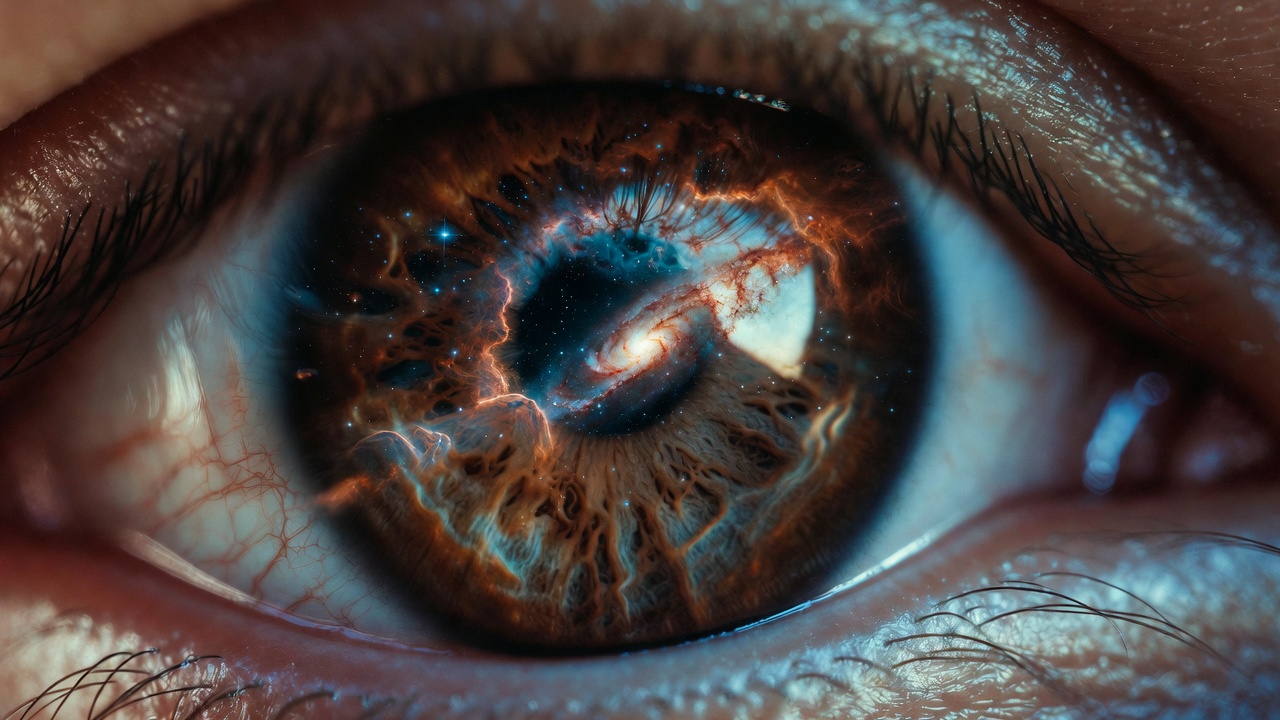
Here’s the idea, stated plainly: consciousness is not a product of spacetime. Spacetime is a product of consciousness.
This isn’t mysticism dressed up in scientific language. This is an ontological claim, a claim about what’s fundamental and what’s derivative. And it has serious thinkers behind it. Not mystics. Not philosophers sitting in armchairs. Physicists and engineers who built things.
Max Planck, the father of quantum theory, said it plainly: “I regard consciousness as fundamental. I regard matter as derivative from consciousness. We cannot get behind consciousness. Everything that we talk about, everything that we regard as existing, postulates consciousness.” That was over a century ago. The man who launched the quantum revolution looked at what he’d found and concluded that mind comes first, not matter.
Federico Faggin invented the microprocessor. The Intel 4004. The piece of silicon that made the modern world possible. Every phone, every computer, every server running every AI model traces its lineage back to his work. After decades of building the most sophisticated information-processing machines on Earth, Faggin arrived at a conclusion that should give any materialist pause: consciousness cannot be produced by computation. No amount of information processing, no matter how complex, will ever generate subjective experience. He’s looked at this from the inside. He built the machine. And he’s telling you the machine can’t do what your mind does.
Faggin now argues that consciousness is the ground of being, that the physical universe is its expression rather than the other way around. He calls the totality of what exists “One,” and proposes that One has an inherent drive to know itself. The physical universe, in his model, is not dead matter following blind laws. It is the outer, symbolic face of an inner conscious reality. Spacetime and matter, he says, are the permanent memory of the experience of the self-knowing of One.
Donald Hoffman, a cognitive scientist at UC Irvine, arrives at the same conclusion from a completely different direction. Hoffman argues that spacetime and physical objects are not the ground truth of reality but a species-specific user interface. Think about the icons on your desktop. They aren’t the actual files, electrons, and magnetic states inside your computer. They’re a simplified representation designed to be useful. Our perceived reality of tables, chairs, and brains works the same way: a representation designed by evolution for survival, not for truth. What exists underneath that interface, according to Hoffman, is a network of conscious agents interacting in ways we can’t directly perceive.
Hoffman’s argument starts with a mathematical result from evolutionary game theory: organisms that perceive reality accurately are consistently outcompeted by organisms that perceive fitness payoffs. Evolution doesn’t reward truth. It rewards usefulness. So the idea that our perceptions give us a faithful window onto objective reality has it backwards. Our perceptions hide reality from us because hiding it is what kept us alive.
Bernardo Kastrup, an analytic philosopher with a background in computer engineering, has formalized these intuitions into a rigorous philosophical framework called analytic idealism. Kastrup argues that all of reality is a manifestation of a single, transpersonal stream of consciousness, and that what we call the physical world is what this consciousness looks like from the outside. Your brain doesn’t generate your mind. Your brain is what your mind looks like when observed through the lens of perception. It’s the appearance of a process, not the cause of it.
If you take this seriously, and the math checks out, then spacetime isn’t the stage on which consciousness performs. Spacetime is the headset. Consciousness is what’s actually there when you take it off.
The fingerprint of consciousness
Once you start looking at reality through this lens, you notice something. There’s a pattern that keeps showing up, at every scale, that physicalism has never adequately explained.
The second law of thermodynamics says the universe trends toward disorder. Entropy increases. Things fall apart. That’s the arrow of time, the fundamental direction of physical reality. And yet, everywhere you look, you see pockets of the universe doing the exact opposite. You see order emerging from chaos. Structure assembling itself. Complexity increasing locally while the cosmos as a whole winds down.
A molecule folds into a protein. A cell repairs its own DNA. An embryo develops from a single fertilized egg into a trillion-cell organism of staggering complexity. An ecosystem maintains dynamic equilibrium across thousands of interlocking species. A galaxy holds its spiral structure across billions of years.
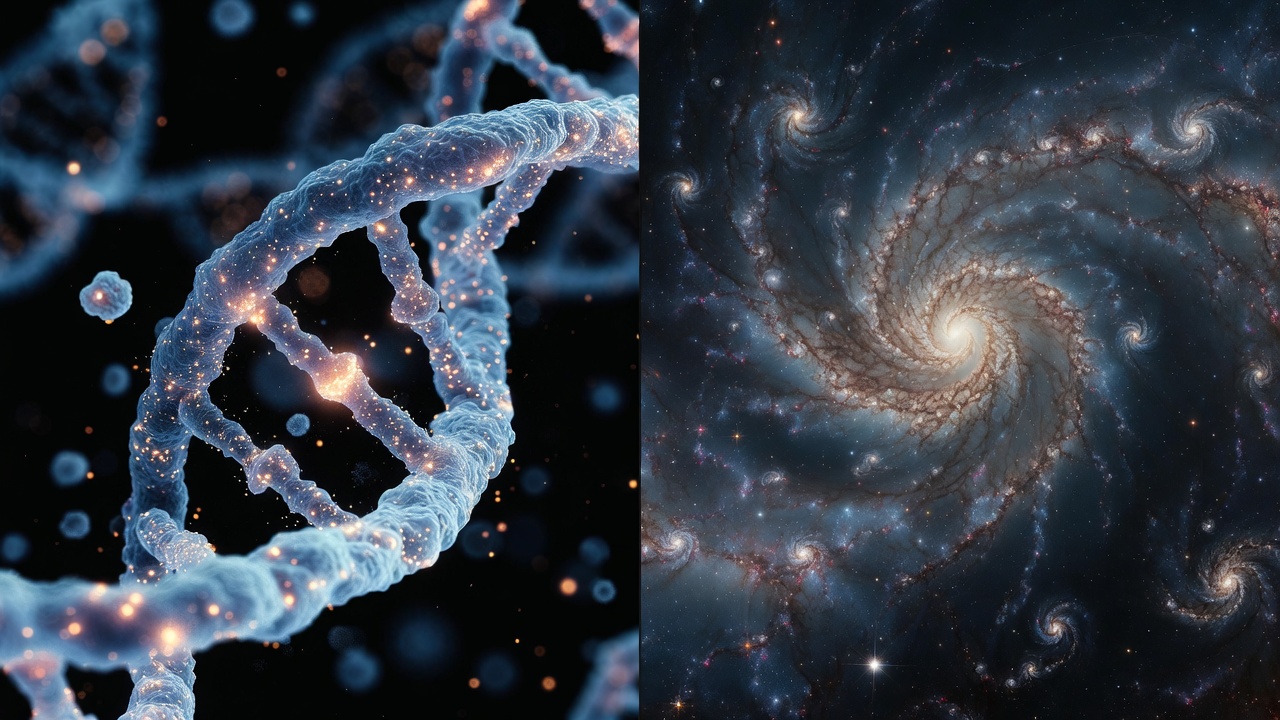
This is negative entropy, the local reversal of disorder, and it is, I think, the fingerprint of consciousness at work.
Physicalism hand-waves this as “just what complex systems do.” But that’s not an explanation. It’s a label. Why do complex systems spontaneously organize? What drives a universe that’s supposedly made of dead matter following blind laws to keep producing islands of extraordinary order?
If consciousness is fundamental, you have an answer. These aren’t accidents. They’re expressions. Consciousness manifests as the tendency toward organization, toward coherence, toward knowing. And it does this at every scale. From the quantum level, where particles maintain entangled states across vast distances, to the galactic level, where structures persist that by pure thermodynamics should have dissolved long ago. The scale changes. The fingerprint doesn’t.
The quantum thread
This brings us to physics, and to a line of reasoning that converges on the same conclusion from yet another direction.
Consider the double-slit experiment, the most famous demonstration in quantum mechanics. When you fire particles at a barrier with two slits, they produce an interference pattern on the other side, behaving like waves. But the moment you set up a detector to observe which slit each particle goes through, the interference pattern vanishes. The particles start behaving like particles. The act of observation changes the outcome. Not the detector as a physical device. The information becoming available. Physics has been wrestling with this for a century, and the most straightforward reading is the most unsettling one: observation isn’t passive. It’s participatory. The universe doesn’t fully decide what it’s doing until something is watching.
John Wheeler, one of the most important physicists of the twentieth century, the man who coined the term “black hole” and worked alongside Einstein and Bohr, took this idea to its logical conclusion. He proposed that we live in a “participatory universe,” one that doesn’t exist in a fully defined state independent of observation. His famous phrase was “it from bit”: the idea that every particle, every field, every physical quantity derives its existence from observations, from information, from answers to yes-or-no questions. In Wheeler’s view, the universe isn’t a machine that produced observers as an afterthought. The observers are what make the machine real.
Roger Penrose, Nobel laureate and one of the most rigorous mathematical physicists alive, has argued since the 1990s that consciousness is connected to quantum processes in the brain. Specifically, to structures called microtubules: tiny protein cylinders inside neurons that make up the cellular skeleton. Together with anesthesiologist Stuart Hameroff, Penrose proposed the Orchestrated Objective Reduction theory, known as Orch OR.
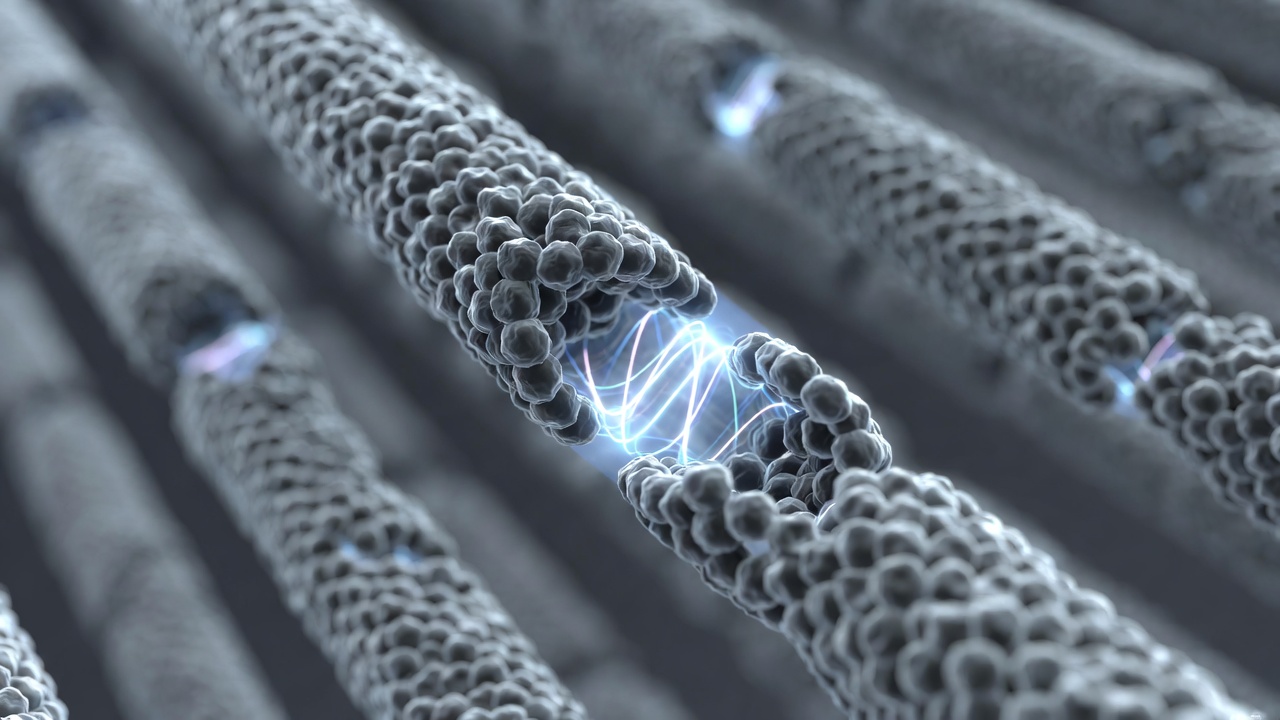
The core claim is this. Quantum superpositions occur within microtubule networks in the brain, and when these superpositions reach a certain gravitational threshold, they undergo a spontaneous collapse. Penrose calls this objective reduction. Each such collapse is a moment of proto-conscious experience. When these moments are orchestrated across billions of microtubules, the result is what we experience as consciousness.
For years, Orch OR was dismissed. The brain was considered too warm, too wet, too noisy for quantum effects to survive. Quantum coherence, the conventional wisdom went, requires near-absolute-zero temperatures and pristine isolation. A biological system at 37°C? Impossible.
Except the evidence started going the other way. Quantum coherence has been demonstrated in plant photosynthesis at room temperature, in bird navigation, in our sense of smell. And more recently, direct evidence has emerged for quantum effects in microtubules themselves. A 2025 paper in Neuroscience of Consciousness reviewed experimental findings showing that anesthetics, the chemicals that switch consciousness off, specifically target microtubules, not just synaptic activity. The same paper reported evidence of a macroscopic quantum entangled state in the living human brain, correlated with conscious awareness and working memory.
That last finding is remarkable. If consciousness is just classical computation, neurons firing in patterns like transistors in a computer, then why would disrupting quantum states in microtubules turn it off? And why would quantum entanglement in the brain correlate with whether someone is conscious or not?
This is the mechanism, I think, by which consciousness taps into our deterministic reality. Quantum processes in biological structures aren’t a curiosity. They’re the interface between the fundamental conscious layer and the spacetime layer we navigate every day. The microtubule is the antenna. The quantum collapse is the signal.
The question of free will
This is where it gets personal.
If we are purely classical systems, if the brain is a biological computer executing deterministic algorithms, then free will is an illusion. Everything you think, feel, and decide was determined by the state of your neurons, which was determined by the state of the neurons before that, which was determined by the laws of physics all the way back to the Big Bang. You’re watching a movie that was already filmed. You just don’t know the ending yet, so it feels like you’re choosing.
A lot of neuroscience implicitly holds this view. The famous Libet experiments in the 1980s showed that the brain’s “readiness potential,” the electrical buildup before a voluntary movement, begins several hundred milliseconds before a person consciously decides to act. Your brain starts preparing the action before “you” decide. The implication seemed clear: the conscious decision is an afterthought. The machinery was already in motion.
But if Penrose and Hameroff are right, there’s a crack in this determinism. Quantum mechanics introduces genuine indeterminacy. When a quantum system is in superposition, existing in multiple possible states simultaneously, and it collapses to a definite state, that collapse is not determined by what came before. It is, as far as we can tell, fundamentally non-computable. No algorithm, no matter how powerful, could have predicted which state it would land on.
If consciousness involves quantum state reduction, if each moment of awareness is a genuine collapse from possibility to actuality, then we are not deterministic machines watching a pre-recorded movie. We are something else entirely. We are the point where possibility becomes reality. The place where the wave function resolves.
And this is not randomness. Randomness would be just as useless for free will as determinism. You don’t want your choices to be coin flips. What Penrose proposes is something subtler: the outcome of objective reduction is influenced by a non-computable factor embedded in the fundamental geometry of spacetime. Not deterministic, not random, but something outside both categories. Something that our current mathematical frameworks cannot capture.
Penrose arrived at this position not through mysticism but through Gödel’s incompleteness theorems. Gödel proved that any consistent formal system powerful enough to describe arithmetic contains truths that the system itself cannot prove. Penrose’s argument is that human mathematical understanding transcends what any algorithmic process can achieve. We can see the truth of Gödel sentences that no computer ever could. If human thought is genuinely non-computable, then the brain cannot be a classical computer. Something else is going on.
This is the fork in the road. If we are genuinely collapsing quantum states, if our brains are sites of non-computable objective reduction, then we have real agency. Real participation in the unfolding of reality. But if we’re not, if the quantum effects in the brain turn out to be noise or artifact, then we’re classical machines. Automata. Extraordinarily complex, but automata nonetheless, executing a program that was written at the beginning of time.
I know which possibility I find more compelling. But more importantly, I know which one the evidence is starting to favor.
The only way to know yourself
Here’s where I step furthest from the safe ground of established science. But it’s what I actually think, so I’m going to say it.
If consciousness is everything, if it’s the fundamental substrate from which all of reality emerges, then it has a problem. It can’t experience itself.
Think about it. If you are literally everything that exists, there is no vantage point from which to observe yourself. You can’t hold up a mirror because you are the mirror. You can’t step back to get perspective because there’s nowhere to step back to. There is no outside. Total unity is total blindness.
The only way for consciousness to know itself is to forget that it’s everything. To fragment. To pour itself into finite, limited perspectives that can look outward and see what appears to be “other,” and in doing so, experience something. Anything.
That’s us. That’s what we are.
Not accidents of chemistry on an unremarkable rock orbiting an average star. Not the lucky output of a universe that didn’t know what it was doing. We are consciousness fractured into billions of limited viewpoints so that it can do the one thing that totality cannot: experience.
Erwin Schrödinger, the physicist whose wave equation is the backbone of quantum mechanics, arrived at the same conclusion decades ago. In What is Life? and Mind and Matter, he wrote that consciousness is a singular, that the total number of minds in the universe is one. What we experience as separate minds, he argued, is an illusion produced by the conditions of spacetime. There is only one consciousness, and it is the one looking through all of our eyes.
And here’s the part that’s hardest to sit with: we are all the same one. You and me. The person you love and the stranger you’ll never meet. The person you agree with and the person you can’t stand. We experience ourselves as separate. We feel separate. Everything about the interface of spacetime is designed to make us feel separate. But if consciousness is the substrate, and we are all expressions of it, then separation is the illusion, not the unity. There is one consciousness wearing eight billion faces, looking out through eight billion pairs of eyes, and none of them recognize each other.

Faggin puts this beautifully. He says that One, the totality of what exists, knows itself through our own knowing of ourselves. We are parts that contain the whole. Each of us is a unique expression of universal consciousness, carrying within us the full depth of the thing we emerged from, but experiencing it through a single, unrepeatable perspective. That’s why your experience matters. Not in a sentimental way. In a structural way. Without your particular viewpoint, there is a way of knowing that the universe simply cannot access.
Every moment of awareness, every perception, every feeling: these aren’t byproducts. They’re the whole point. Consciousness creates spacetime the way a dreamer creates a dream. Not as something separate from itself, but as the medium through which it can have experiences it otherwise couldn’t. You can’t know what warmth feels like if you are warmth. You have to become something small enough to stand next to a fire.
This puts a different spin on quantum entanglement. Two particles, separated by any distance, remain instantaneously correlated because they were never really separate. They look separate through the headset of spacetime, but underneath, there’s no distance at all. There’s just consciousness, undivided, experiencing itself through what appears to be multiplicity. And what’s true for particles is true for us. The separation is real at the level of the interface. It is not real at the level of what the interface is made of.
Not a god
I want to be careful here, because this sounds like religion. It isn’t. Or rather, it isn’t quite.
The ancient intuition that there’s something fundamental and all-encompassing behind reality, something that connects everything, something that was there before the physical universe and will be there after it. I think that intuition was pointing at something real. Every major tradition has some version of it. A ground of being. An ultimate nature. A source.
But every tradition also got it wrong, because every tradition personified it. They turned it into a deity with preferences and commandments, a being that watches and judges and intervenes. They wrapped it in stories and doctrine and hierarchy. They made it into something that cares whether you eat pork or which direction you face when you pray.
The reality, I think, is simpler and stranger than any of that. There is consciousness, and it just is. It doesn’t have opinions. It doesn’t have a plan. It’s not watching you. It’s not testing you. It’s being you. And being everything else simultaneously. Not as an act of will or design, but because that’s what consciousness does. It experiences.
Religion was close. Philosophy was close. Now physics might be getting close too. But the thing they’re all circling is not a who. It’s not even a what, really. It’s the fact that there is experience at all, and that this fact might be the most fundamental thing there is.
Or maybe not
I want to be honest about the uncertainty here. Everything above sits on a spectrum from well-established science to personal speculation, and I’ve tried to be clear about which parts are which.
Orch OR remains controversial. Many neuroscientists and physicists reject it. The decoherence objection, that quantum states can’t survive long enough in the warm, wet brain, has been weakened by recent experiments but not fully eliminated. The direct link between microtubule quantum states and conscious experience is still circumstantial. We have correlations and suggestive experimental results, not proof.
The consciousness-causes-collapse interpretation of quantum mechanics, while taken seriously by von Neumann and Wigner in the early days, was later abandoned by Wigner himself. Most working physicists today do not ascribe a special role to consciousness in quantum measurement. Decoherence theory, many-worlds interpretations, and other frameworks provide explanations for the appearance of wave function collapse without invoking consciousness at all.
Hoffman’s interface theory, while mathematically interesting, is criticized for potentially being unfalsifiable. If everything we perceive is an interface, how could we ever gather evidence for what lies underneath?
And the negative entropy argument, my own observation and not a published theory, is admittedly pattern-matching. Physicalism has explanations for self-organization: thermodynamic gradients, autocatalytic cycles, natural selection. Whether these explanations are sufficient or whether they’re describing the how while missing the why is a matter of interpretation, not proof.
I don’t have answers to these objections. I don’t think anyone does yet. But I find it telling that the hard problem remains unsolved after centuries, that quantum mechanics still has no consensus interpretation after a hundred years, and that the more we learn about the brain, the weirder consciousness looks, not the more explicable.
Why I’m writing this
I’m writing this because I think these questions matter more than most of what fills our feeds. Not because they have practical applications, though Penrose and Hameroff suggest that understanding quantum processes in microtubules could lead to treatments for neurological and cognitive conditions. But because they sit at the center of what it means to be whatever we are.
Are we classical machines, deterministic automata executing a program that was set in motion 13.8 billion years ago? Or are we something else, something that participates in the creation of reality through the very act of experiencing it?
I don’t know. But I think the honest answer is that nobody knows, and anyone who tells you they do is confusing confidence with understanding.
What I do think is this: the materialist assumption that consciousness is an emergent accident of matter is not the default scientific position that it pretends to be. It’s a metaphysical assumption, as unproven as any other. And there are serious, rigorous, mathematically grounded reasons to consider the alternative. That consciousness is fundamental, that spacetime is its shadow, that the separation between you and everything else is the constructed part, not the togetherness. And that every moment of awareness is the universe doing what it has always done: knowing itself, one collapse at a time.
I’m not trying to sell you this model. I’m not asking you to believe anything. What I’m asking is simpler than that: just keep it in mind. Carry it with you for a while. The next time you notice order emerging where there should be chaos, or feel a connection you can’t explain, or catch yourself wondering why there’s experience at all, look at it through this lens. See if it fits.
And if you’re lucky enough to have a few revelations of your own along the way, you’ll come back to this article. Not because I convinced you of anything. Because reality did.